A better way to read Scripture — with curiosity, context, and clarity.
You are not missing faith. You may be missing context, tools, and better reading instincts.
Most people were taught to defend, extract, and harmonize the Bible before they were taught how to read it in its ancient world. They were handed conclusions before they were handed tools.
The result is readers who can feel anxious when a passage is confusing, defensive when someone raises a hard question, or stuck when their tradition's answers don't quite satisfy.
These 14 instincts exist to change that. They help you slow down, ask better questions, recover ancient context, and read Scripture with more confidence — not because the Bible gets easier, but because you get better at reading it.
A Confident Reader is not someone who has every answer.
A Confident Reader is someone who has learned how to approach Scripture with curiosity, context, humility, and practiced reading instincts — and who knows what to do when a passage feels confusing, difficult, ancient, or unfamiliar.
A Confident Reader learns to do four things. The 14 instincts below simply unpack those four movements.
Pause before defending, dismissing, or deciding. Notice what the text is doing and what you are bringing to it.
Ask what a passage meant in its original context — its genre, culture, and assumptions — before asking what it means for you.
Check what words actually meant in their ancient world. Know that every translation is an interpretation. Compare versions and ask good questions.
Test your interpretations with other careful readers. Allow Scripture to form you rather than only inform you.
The 14 instincts below unpack each of these movements in greater depth.
Fourteen instincts, built to work together — from the foundation of your reading to how you interpret, test, and apply what you find.
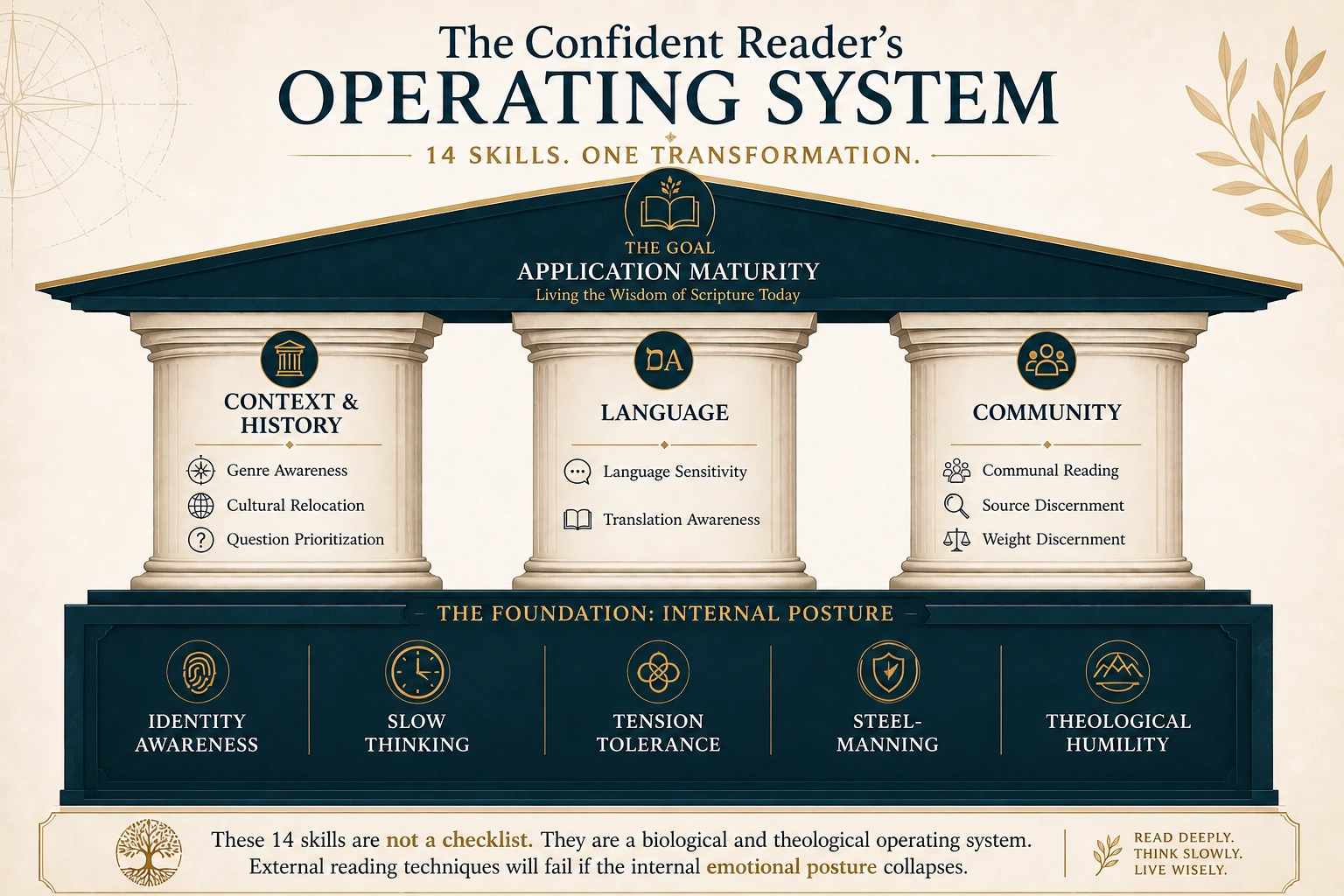
The 14 instincts are not a random list. They build on each other — from the inner habits that make careful reading possible, to the context, language, and community practices that help Scripture come into focus.
Inner habits that make careful reading possible — self-awareness, slow thinking, tension tolerance, intellectual honesty, and theological humility.
Recovering the ancient world of the text — genre, culture, covenant, honor and shame, and the assumptions of the original audience.
Paying attention to words, translation choices, ancient vocabulary, and how meaning shifts across languages and centuries.
Reading Scripture with humility, testing interpretations with other careful readers, and allowing Scripture to form us rather than merely inform us.
These are not topics to master before you begin. They are instincts you develop as you read. Each one creates a doorway into a more confident way of approaching Scripture. Select any instinct to expand it.
We all interpret through communities — families, churches, traditions. When a reading feels dangerous, it is often because changing your mind would cost you something socially. Naming that pressure is not a sign of weak faith. It is honest self-awareness.
You notice that a particular interpretation makes you feel like a traitor to your tradition. You ask yourself: "Am I resisting this because it's wrong, or because it would be costly?"
Most of us have been trained to respond quickly — to have an answer, take a position, defend a belief. Slow thinking is the decision to interrupt that pattern. It is not indecision. It is the prerequisite for every other instinct on this list.
You read a verse that seems to contradict what you've always believed. Instead of immediately defending your position, you pause. You notice the reaction. You stay with the question.
Confident Readers have learned that not every tension needs to be resolved right now — or ever. This is sometimes called negative capability: the capacity to remain in uncertainty without rushing toward a forced answer. Non-resolution is not failure. It is intellectual maturity.
Two scholars you respect disagree about the meaning of a passage. Instead of immediately picking a side, you hold both positions. You let the tension do its work.
A straw man is easy to defeat. A steel man requires you to understand a view well enough to argue for it — even if you reject it. This practice builds intellectual honesty and often reveals more complexity than you expected.
You disagree with an interpretation of the atonement. Before dismissing it, you write three sentences making the best possible case for it — as if you were defending it to someone who held your current view.
Confident Readers can hold their beliefs firmly without treating every question as a threat to their faith. Humility does not mean having no convictions. It means knowing the difference between what is essential and what is your current best understanding.
You realize you've always read a passage one way. New evidence suggests a different reading. Instead of panicking, you think: "My faith doesn't depend on this interpretation being correct."
The Bible is not one book. It is a library — poetry, narrative, prophecy, law, apocalyptic vision, letter, wisdom. Each type of writing operates by different rules. Reading poetry as history, or apocalyptic as newspaper prediction, is one of the most common sources of confusion and conflict.
You encounter "the stars fought from heaven" in Judges 5. Knowing it is battle poetry, not a report of celestial warfare, you read it for what it is: a celebration of victory.
The Bible was written for us but not to us. It was addressed to ancient communities with different assumptions about honor, shame, purity, covenant, and identity. Reading it without entering their world means unconsciously replacing their assumptions with ours.
You read about Joseph's "coat of many colors" and remember: this is a long-sleeved administrative robe — a sign of privilege and authority. Suddenly the brothers' rage makes perfect sense.
This sequence is everything. Personal application is legitimate and important — but only after the original meaning has been honored. Reversing the order produces reading that is emotionally satisfying but historically untethered.
Before asking how Romans 8:28 applies to your situation, you first ask: Who is Paul writing to? What are they facing? What does "all things" mean in that context?
Ancient words lived in ancient worlds. Terms like faith, salvation, flesh, holy, forever, and gospel do not automatically mean what modern English usage suggests. Meaning is determined by context, genre, and authorial intent — not by dictionary definitions or word origins.
Someone insists that "pharmakeia" in Revelation refers to modern pharmaceuticals. You ask: What did this word mean in the first century? You discover it referred to ritual magic — not prescription medication.
Every Bible translation is an interpretation. No single version perfectly captures the full range of meaning in the original languages and cultural context. Comparing translations does not undermine the Bible. It enriches it.
You notice that one translation says "mercy seat" where another says "sacrifice of atonement." Instead of assuming one is wrong, you ask: What is each translation trying to capture? What does that tell me about the original word?
Most of us were formed to read the Bible privately and personally. But Scripture was read aloud in gatherings, interpreted in community, and addressed to groups. The "you" in most letters is plural. Solitary reading is valuable — but community is one of the best checks against misreading.
You have an interpretation you've been developing alone. You bring it to a group of careful readers. Their questions expose two assumptions you hadn't noticed.
Confident Readers do not simply adopt the views of those who sound authoritative. They ask: Does this teacher make the Bible more ancient or more modern? Do they cite primary sources? Do they acknowledge limits? Do they empower me to study — or require me to depend on them?
A popular teacher claims a Greek word "clearly means" X, citing only their own authority. You notice they've made the text more dramatic but less ancient. You treat it as a starting point, not a conclusion.
Not every interpretive disagreement threatens the gospel. Confident Readers learn to identify what is load-bearing in their faith and what is not — so they can hold secondary questions loosely without feeling like their entire foundation is at risk.
You realize you've been treating a debated question about end-times chronology with the same urgency as the resurrection. You ask: Is this actually essential? What are the stakes if I'm wrong here?
The goal of Bible reading is not to accumulate ammunition for arguments. It is transformation — of character, perspective, and life. Mature application asks not just what a passage means, but what kind of person it calls you to become.
You finish a difficult study on divine judgment. Instead of immediately applying it to other people's theology, you ask: What does this reveal about God's character? What does it call me to trust? How does it change how I live?
Begin with Read the Bible with Confidence — a free 5-day mini-course delivered by email when you join the Faith of Messiah newsletter. You'll learn the first steps toward reading Scripture with more context, curiosity, and clarity.
